System improvement and engineering experiments
Goal
Turn concepts into inspectable inputs, operations, gradients, and comparisons.
Evidence: real snapshots + controlled drift/social simulation. Local teaching parameters are not production defaults; mechanism experiments are not full reproductions of the original papers.
English companion. All instructional Markdown is translated. Experiment code, Chinese language examples, execution counts, and saved outputs remain as in the source edition; historical output text may therefore be Chinese. The initial setup cell anchors the working directory and Python import path for this companion's deeper folder; it does not change the experiment. Saved outputs are historical evidence, not a new run. Run from the top after preparing the required data and models.
# English companions live one directory deeper; keep the original experiment code unchanged.
from pathlib import Path as _TranslationPath
import os as _translation_os
import sys as _translation_sys
_translation_root = next((p for p in [_TranslationPath.cwd(), *_TranslationPath.cwd().parents]
                          if (p / "reclab").is_dir()), None)
if _translation_root is None:
    raise RuntimeError("Open this notebook from inside the Search Recommendation Ads Lab checkout.")
_translation_os.chdir(_translation_root)
if str(_translation_root) not in _translation_sys.path:
    _translation_sys.path.insert(0, str(_translation_root))
Setup
On the first pass, run from Setup in order: later cells reuse earlier variables. Then change one parameter and rerun that cell and its downstream cells. Constructed data does not establish real business impact.
from pathlib import Path
import sys
import inspect
import numpy as np
import pandas as pd
import matplotlib.pyplot as plt
from IPython.display import display, Code

PROJECT = next(p for p in [Path.cwd(), *Path.cwd().parents]
               if (p / "reclab/models.py").exists())
if str(PROJECT) not in sys.path:
    sys.path.insert(0, str(PROJECT))
from reclab.data import Dataset
from reclab.paths import ARTIFACTS, PROCESSED, read_json

plt.rcParams.update({"figure.figsize": (9, 3.8), "font.size": 11,
    "axes.spines.top": False, "axes.spines.right": False,
    "axes.labelcolor": "#182b2b", "text.color": "#182b2b",
    "axes.facecolor": "white", "figure.facecolor": "white",
    "grid.color": "#d4ddda", "axes.axisbelow": True})
dataset = Dataset()
print("Project:", PROJECT)
print("Dataset version:", dataset.manifest["dataset_version"])
print("Python:", sys.executable)
assert Path(sys.executable).parent == PROJECT / ".venv/bin", "请选择 Recommendation Lab 内核"
Saved notebook output · not executed on this page
Project: /Users/lizuolin/local/recommendation-lab
Dataset version: 2772cab0aca8cb81
Python: /Users/lizuolin/local/recommendation-lab/.venv/bin/python
Steps
Lecture references: 08_Improvement_01.pdf, 08_Improvement_02.pdf, 08_Improvement_03.pdf, 08_Improvement_04.pdf, 08_Improvement_05.pdf, 08_Improvement_06.pdf
Retrieval quotas and deduplication
Popular, ItemCF, and two-tower candidates come from real training snapshots. The sum of per-channel counts is not the number after deduplication.
Predict first: With a fixed total budget, which quality, coverage, and latency metrics should you inspect while adjusting quotas?
from scipy import sparse
from reclab.retrieval import cf_scores,topk
from reclab.train import load_model,model_scorer
user=next(iter(dataset.histories));sim=sparse.load_npz(ARTIFACTS/"baselines/itemcf.npz")
model,report=load_model(dataset,"baseline-history32");scorer,_=model_scorer(dataset,model)
channels={"popular":topk(dataset.popularity,100,dataset.seen[user]),
    "itemcf":topk(cf_scores(sim,dataset.histories[user],dataset.n_items),100,dataset.seen[user]),
    "tower":topk(scorer(user),100,dataset.seen[user])}
display(pd.DataFrame([{"per_channel":n,"sum_before":3*n,
    "unique_after":len(set().union(*(set(ids[:n]) for ids in channels.values())))} for n in [10,30,100]]))
Saved notebook output · not executed on this page
| per_channel | sum_before | unique_after | |
|---|---|---|---|
| 0 | 10 | 30 | 30 |
| 1 | 30 | 90 | 90 |
| 2 | 100 | 300 | 295 |
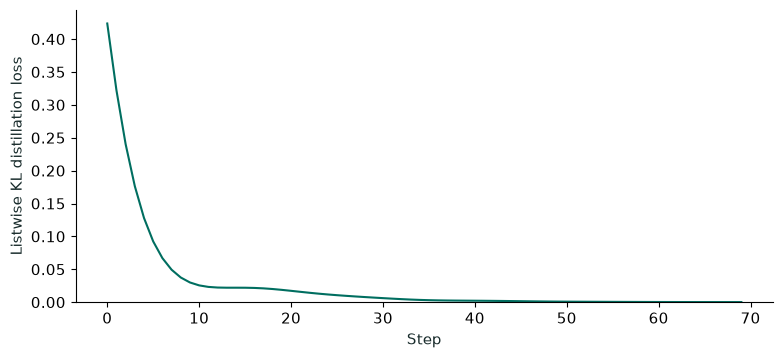
Distillation from ranking to pre-ranking
Controlled teacher/student scores check KL direction and gradients; no complete ranking teacher is claimed.
Predict first: If the teacher is poor, is fitting it more closely necessarily better?
import torch
from reclab.learning.systems import distillation_loss
torch.manual_seed(42);torch.set_num_threads(4)
teacher=torch.randn(8,20);student=torch.nn.Parameter(torch.zeros(8,20))
opt=torch.optim.Adam([student],lr=.15);curve=[]
for _ in range(70):
    opt.zero_grad();loss=distillation_loss(student,teacher,2.)
    loss.backward();opt.step();curve.append(float(loss.detach()))
assert curve[-1]<curve[0]
plt.plot(curve,color="#006e60");plt.xlabel("Step");plt.ylabel("Listwise KL distillation loss");plt.ylim(bottom=0);plt.show()
Saved notebook output · not executed on this page
<Figure size 900x380 with 1 Axes>
Full retraining, incremental training, and distribution drift
Change a controlled binary-classification rule to compare continued training with restarting. Training accuracy is not generalization or evidence of online benefits from a long-lived model.
Predict first: How much old data should remain to balance forgetting against adaptation to the new distribution?
torch.manual_seed(42)
x=torch.randn(512,4);old_y=(x[:,0]+x[:,1]>0).float();new_y=(-x[:,0]+x[:,1]>0).float()
def fit(net,label,steps):
    optimizer=torch.optim.SGD(net.parameters(),lr=.2)
    for _ in range(steps):
        optimizer.zero_grad();loss=torch.nn.functional.binary_cross_entropy_with_logits(net(x).squeeze(-1),label)
        loss.backward();optimizer.step()
    return net
old=fit(torch.nn.Linear(4,1),old_y,80)
import copy
incremental=fit(copy.deepcopy(old),new_y,20);fresh=fit(torch.nn.Linear(4,1),new_y,20)
display(pd.DataFrame([{"model":name,"new_distribution_training_accuracy":float(((net(x).squeeze(-1)>0)==new_y.bool()).float().mean())}
    for name,net in [("old",old),("incremental20",incremental),("fresh20",fresh)]]))
Saved notebook output · not executed on this page
| model | new_distribution_training_accuracy | |
|---|---|---|
| 0 | old | 0.533203 |
| 1 | incremental20 | 0.710938 |
| 2 | fresh20 | 0.919922 |
User segments, diversity, exploration, and social signals
Segment users by training-period activity. Follow, creator, and external-return fields are absent; social relations use an explicitly constructed dictionary. Static logs cannot establish long-term gains from an exploration rate.
Predict first: Why should next week's activity never be used to segment today's users?
activity=pd.Series({u:len(h) for u,h in dataset.histories.items()})
groups=pd.cut(activity,bins=[0,10,50,np.inf],labels=["low","medium","high"])
display(groups.value_counts(sort=False).to_frame("training-defined users"))
synthetic_follows={"u1":{"authorA","authorB"}}
synthetic_items={"authorA":["i1","i2"],"authorB":["i3"]}
social={i for author in synthetic_follows["u1"] for i in synthetic_items[author]}
assert social=={"i1","i2","i3"}
print("Synthetic U2A2I:",sorted(social))
print("MMR/diversity experiments: chapter 08. Exploration 2% is a hypothesis, not a universal default.")
Saved notebook output · not executed on this page
| training-defined users | |
|---|---|
| low | 3843 |
| medium | 2643 |
| high | 248 |
Synthetic U2A2I: ['i1', 'i2', 'i3']
MMR/diversity experiments: chapter 08. Exploration 2% is a hypothesis, not a universal default.
Checks
Every assertion and output is traceable to code. They check operators, data snapshots, or mechanisms, not online gains.
Next steps
Record your prediction, change only one variable, and run the relevant experiment cell. Open reclab/learning/ to inspect helper functions.