02 · Two towers: source code, tensors, gradients, and real training
Goal
Move from an editable Python network to actual training. Change dimensions, history length, or learning rate; open reclab/models.py in the file browser to modify the actual network.
Run All creates a new model version in the final step, preserving existing data and models. First inspect small-batch mathematics, then run the project's shared trainer. The test set is not used.
English companion. All instructional Markdown is translated. Experiment code, Chinese language examples, execution counts, and saved outputs remain as in the source edition; historical output text may therefore be Chinese. The initial setup cell anchors the working directory and Python import path for this companion's deeper folder; it does not change the experiment. Saved outputs are historical evidence, not a new run. Run from the top after preparing the required data and models.
# English companions live one directory deeper; keep the original experiment code unchanged.
from pathlib import Path as _TranslationPath
import os as _translation_os
import sys as _translation_sys
_translation_root = next((p for p in [_TranslationPath.cwd(), *_TranslationPath.cwd().parents]
                          if (p / "reclab").is_dir()), None)
if _translation_root is None:
    raise RuntimeError("Open this notebook from inside the Search Recommendation Ads Lab checkout.")
_translation_os.chdir(_translation_root)
if str(_translation_root) not in _translation_sys.path:
    _translation_sys.path.insert(0, str(_translation_root))
Setup
Use the project's Search Recommendation Ads Lab (Python 3.12) kernel (older saved metadata may call it Recommendation Lab). Users and items below come from the existing real training set. Small-batch exercises check gradients; they do not establish improved recommendation quality.
from pathlib import Path
import sys
import inspect
import numpy as np
import pandas as pd
import matplotlib.pyplot as plt
from IPython.display import display, Code

PROJECT = next(p for p in [Path.cwd(), *Path.cwd().parents]
               if (p / "reclab/models.py").exists())
if str(PROJECT) not in sys.path:
    sys.path.insert(0, str(PROJECT))
from reclab.data import Dataset
from reclab.paths import ARTIFACTS, PROCESSED, read_json

plt.rcParams.update({"figure.figsize": (9, 3.8), "font.size": 11,
    "axes.spines.top": False, "axes.spines.right": False,
    "axes.labelcolor": "#182b2b", "text.color": "#182b2b",
    "axes.facecolor": "white", "figure.facecolor": "white",
    "grid.color": "#d4ddda", "axes.axisbelow": True})
dataset = Dataset()
print("Project:", PROJECT)
print("Dataset version:", dataset.manifest["dataset_version"])
print("Python:", sys.executable)
assert Path(sys.executable).parent == PROJECT / ".venv/bin", "请选择 Recommendation Lab 内核"
Saved notebook output · not executed on this page
Project: /Users/lizuolin/local/recommendation-lab
Dataset version: 2772cab0aca8cb81
Python: /Users/lizuolin/local/recommendation-lab/.venv/bin/python
import torch
from torch import nn
from torch.nn import functional as F
import reclab.models as model_module
from reclab.models import TwoTower
torch.set_num_threads(4)
torch.manual_seed(42)
DIM = 32
HISTORY_LEN = 20
BATCH = 8
TEMPERATURE = 0.1
Steps
1. Inspect the current network source
This is the class used by the web service. Edit reclab/models.py in the file browser. After saving, restart the kernel and run from the beginning, or use the module reload in the final training cell.
print(inspect.getfile(TwoTower))
display(Code(inspect.getsource(TwoTower), language="python"))
Saved notebook output · not executed on this page
/Users/lizuolin/local/recommendation-lab/reclab/models.py
class TwoTower(nn.Module):
    def __init__(self, n_users, n_items, dim=32, use_history=True, dropout=0.1):
        super().__init__()
        self.use_history = use_history
        self.user_embedding = nn.Embedding(n_users, dim)
        self.item_embedding = nn.Embedding(n_items, dim, padding_idx=0)
        self.user_mlp = nn.Sequential(
            nn.Linear(dim * 2, dim * 2),
            nn.ReLU(),
            nn.Dropout(dropout),
            nn.Linear(dim * 2, dim),
        )
        self.item_mlp = nn.Sequential(
            nn.Linear(dim, dim * 2), nn.ReLU(), nn.Linear(dim * 2, dim)
        )

    def encode_user(self, users, history):
        mask = (history != 0).unsqueeze(-1)
        pooled = (self.item_embedding(history) * mask).sum(1) / mask.sum(1).clamp_min(1)
        if not self.use_history:
            pooled = torch.zeros_like(pooled)
        return F.normalize(
            self.user_mlp(torch.cat([self.user_embedding(users), pooled], dim=-1)),
            dim=-1,
        )

    def encode_item(self, items):
        return F.normalize(self.item_mlp(self.item_embedding(items)), dim=-1)

    def loss(self, users, history, targets, temperature=0.1, logq=None):
        # In-batch sampled softmax. Duplicate positive IDs are accidental hits, not negatives.
        logits = (
            self.encode_user(users, history) @ self.encode_item(targets).T / temperature
        )
        if logq is not None:
            logits = logits - logq[targets][None, :]
        duplicate = targets[:, None].eq(targets[None, :])
        duplicate.fill_diagonal_(False)
        logits = logits.masked_fill(duplicate, -1e9)
        return F.cross_entropy(logits, torch.arange(len(users), device=users.device))
2. Follow tensor shapes using real samples
Users are [B], histories [B,N], and targets [B]. Both encoders produce [B,D]; multiplying user vectors by transposed target vectors gives [B,B].
users_np, histories_np, targets_np, times_np = dataset.examples(HISTORY_LEN)
users = torch.from_numpy(users_np[:BATCH])
histories = torch.from_numpy(histories_np[:BATCH])
targets = torch.from_numpy(targets_np[:BATCH])
model = TwoTower(dataset.n_users, dataset.n_items, dim=DIM, use_history=True, dropout=0.0)
model.eval()  # 固定本次数学诊断;eval 不等于关闭 autograd
user_vectors = model.encode_user(users, histories)
item_vectors = model.encode_item(targets)
display(pd.DataFrame({"tensor": ["users", "histories", "targets", "user_vectors", "item_vectors"],
    "shape": [list(x.shape) for x in [users, histories, targets, user_vectors, item_vectors]]}))
print("Trainable parameters:", sum(p.numel() for p in model.parameters()))
assert torch.allclose(user_vectors.norm(dim=1), torch.ones(BATCH), atol=1e-6)
Saved notebook output · not executed on this page
| tensor | shape | |
|---|---|---|
| 0 | users | [8] |
| 1 | histories | [8, 20] |
| 2 | targets | [8] |
| 3 | user_vectors | [8, 32] |
| 4 | item_vectors | [8, 32] |
Trainable parameters: 385952
3. Expand sampled softmax loss
Predict first: does lowering temperature sharpen or flatten the distribution?
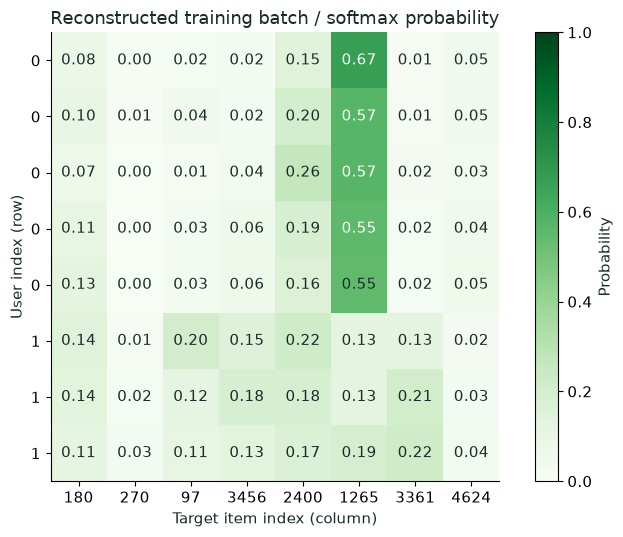
The correct class is on the diagonal of each row. Other targets are in-batch sampled negatives; duplicate targets are masked. LogQ is disabled here to make the basic mathematics easier to check. These negatives are not observed unclicked impressions.
cosine = user_vectors @ item_vectors.T
duplicate = targets[:, None].eq(targets[None, :])
duplicate.fill_diagonal_(False)
logits = (cosine / TEMPERATURE).masked_fill(duplicate, -1e9)
logits.retain_grad()
labels = torch.arange(BATCH)
probabilities = logits.softmax(dim=1)
loss = F.cross_entropy(logits, labels)
model.zero_grad(set_to_none=True)
loss.backward()
expected_gradient = (probabilities.detach() - F.one_hot(labels, BATCH)) / BATCH
assert torch.allclose(logits.grad, expected_gradient, atol=1e-6)
display(pd.DataFrame(probabilities.detach().numpy(), index=users.tolist(), columns=targets.tolist()))
print("Cross-entropy:", float(loss.detach()))
print("dL/dlogit for row 0:", logits.grad[0].tolist())
Saved notebook output · not executed on this page
| 180 | 270 | 97 | 3456 | 2400 | 1265 | 3361 | 4624 | |
|---|---|---|---|---|---|---|---|---|
| 0 | 0.075222 | 0.004755 | 0.016481 | 0.023495 | 0.147182 | 0.670796 | 0.012573 | 0.049495 |
| 0 | 0.097509 | 0.006899 | 0.040241 | 0.024322 | 0.198824 | 0.573799 | 0.008774 | 0.049632 |
| 0 | 0.067674 | 0.002751 | 0.012127 | 0.037660 | 0.259269 | 0.570432 | 0.022318 | 0.027770 |
| 0 | 0.109721 | 0.001928 | 0.027018 | 0.061421 | 0.187387 | 0.552615 | 0.017557 | 0.042352 |
| 0 | 0.127011 | 0.002267 | 0.028390 | 0.062393 | 0.160158 | 0.546719 | 0.018724 | 0.054338 |
| 1 | 0.144987 | 0.011143 | 0.200329 | 0.150079 | 0.215864 | 0.127405 | 0.128882 | 0.021311 |
| 1 | 0.135188 | 0.015927 | 0.120577 | 0.184901 | 0.181037 | 0.128408 | 0.208228 | 0.025733 |
| 1 | 0.114495 | 0.027263 | 0.112846 | 0.134311 | 0.165850 | 0.189183 | 0.218638 | 0.037414 |
Cross-entropy: 2.9391064643859863
dL/dlogit for row 0: [-0.115597203373909, 0.0005943385185673833, 0.002060179365798831, 0.002936860080808401, 0.01839778758585453, 0.08384954929351807, 0.00157161767128855, 0.006186868529766798]
fig, ax = plt.subplots(figsize=(7.5, 5.5))
image = ax.imshow(probabilities.detach().numpy(), cmap="Greens", vmin=0, vmax=1)
ax.set_xticks(range(BATCH), [str(i) for i in targets.tolist()])
ax.set_yticks(range(BATCH), [str(i) for i in users.tolist()])
ax.set(xlabel="Target item index (column)", ylabel="User index (row)",
       title="Reconstructed training batch / softmax probability")
for row in range(BATCH):
    for col in range(BATCH):
        value = float(probabilities[row, col].detach())
        text = "x" if duplicate[row, col] else f"{value:.2f}"
        ax.text(col, row, text, ha="center", va="center", color="white" if value > .55 else "#182b2b")
fig.colorbar(image, ax=ax, label="Probability")
plt.tight_layout(); plt.show()
Saved notebook output · not executed on this page
<Figure size 750x550 with 2 Axes>
4. Overfit a small batch first
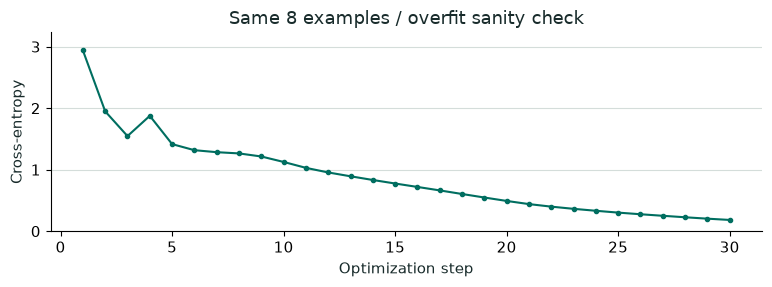
This is a training-code sanity check. It updates only a new in-memory model, preserving saved weights. Lower small-batch loss does not imply better validation metrics.
optimizer = torch.optim.Adam(model.parameters(), lr=0.01)
tiny_losses = []
for step in range(30):
    optimizer.zero_grad(set_to_none=True)
    tiny_loss = model.loss(users, histories, targets, TEMPERATURE)
    tiny_losses.append(float(tiny_loss.detach()))
    tiny_loss.backward()
    optimizer.step()
assert tiny_losses[-1] < tiny_losses[0]
print("Tiny-batch loss:", tiny_losses[0], "->", tiny_losses[-1])
fig, ax = plt.subplots(figsize=(8, 3))
ax.plot(range(1,31), tiny_losses, color="#006e60", marker=".")
ax.set(xlabel="Optimization step", ylabel="Cross-entropy", title="Same 8 examples / overfit sanity check", ylim=(0, max(tiny_losses)*1.1))
ax.grid(axis="y"); plt.tight_layout(); plt.show()
Saved notebook output · not executed on this page
Tiny-batch loss: 2.9391064643859863 -> 0.18255160748958588
<Figure size 800x300 with 1 Axes>
5. Try changing the network in this cell
MyTwoTower is an independent learning branch that checks only the forward pass. Replace ReLU with Tanh, or change HIDDEN, and inspect the parameter count and output shapes.
This cell does not replace the main trainer. To use the new architecture in the workbench, edit the actual reclab/models.py, then run the full training cell below.
HIDDEN = 16
class MyTwoTower(TwoTower):
    def __init__(self, n_users, n_items, dim):
        super().__init__(n_users, n_items, dim, use_history=True, dropout=0.0)
        self.user_mlp = nn.Sequential(nn.Linear(2*dim, HIDDEN), nn.ReLU(), nn.Linear(HIDDEN, dim))

sandbox = MyTwoTower(dataset.n_users, dataset.n_items, DIM)
print("Edited user tower:", sandbox.user_mlp)
print("Output shape:", tuple(sandbox.encode_user(users, histories).shape))
print("Parameters:", sum(p.numel() for p in sandbox.parameters()))
Saved notebook output · not executed on this page
Edited user tower: Sequential(
  (0): Linear(in_features=64, out_features=16, bias=True)
  (1): ReLU()
  (2): Linear(in_features=16, out_features=32, bias=True)
)
Output shape: (8, 32)
Parameters: 381296
6. Run the real project trainer and save a new version
Change only one variable in EXPERIMENT first. Saved models, configurations, and curves appear in the workbench's training view after a refresh. Training uses the full training subset and the fixed validation protocol, not the eight samples above for evaluation.
Reload reads your saved models.py and train.py. After changing architecture, train a fresh model; do not load an old checkpoint into an incompatible network.
import importlib
import reclab.train as train_module
importlib.reload(model_module)
train_module = importlib.reload(train_module)

EXPERIMENT = train_module.TrainConfig(
    name="notebook / first-full-run", dim=32, history_len=20,
    epochs=4, batch_size=256, learning_rate=0.003,
    use_history=True, logq_correction=False, seed=42,
)
new_run = train_module.train(EXPERIMENT)
print("Saved run:", new_run["run_id"])
display(pd.Series(new_run["validation"]["metrics"], name="validation score").to_frame())
Saved notebook output · not executed on this page
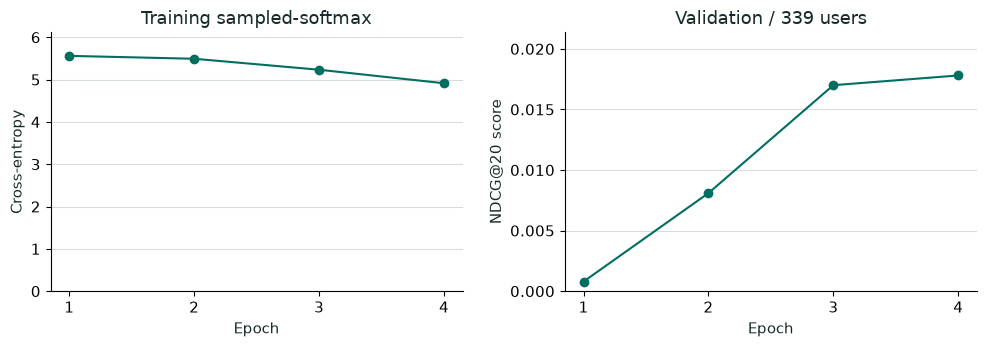
20261028T023407346105 {'epoch': 1, 'loss': 5.560806380245401, 'gradient_norm_before_clip': 0.3162150839824632, 'validation_ndcg@20': 0.0007904414175060725, 'validation_recall@20': 0.000609776941282452, 'elapsed_seconds': 1.81}
20261028T023407346105 {'epoch': 2, 'loss': 5.492199623965221, 'gradient_norm_before_clip': 0.32834317195863233, 'validation_ndcg@20': 0.008092865280543902, 'validation_recall@20': 0.014427202969790203, 'elapsed_seconds': 2.38}
20261028T023407346105 {'epoch': 3, 'loss': 5.232908364200719, 'gradient_norm_before_clip': 0.5570250882509169, 'validation_ndcg@20': 0.01700333691787301, 'validation_recall@20': 0.031168373965094427, 'elapsed_seconds': 2.93}
20261028T023407346105 {'epoch': 4, 'loss': 4.913768497700725, 'gradient_norm_before_clip': 0.7106661569904273, 'validation_ndcg@20': 0.017804264366807675, 'validation_recall@20': 0.03713369853338916, 'elapsed_seconds': 3.53}
Saved run: 20261028T023407346105
| validation score | |
|---|---|
| recall@10 | 0.028066 |
| ndcg@10 | 0.014543 |
| mrr@10 | 0.011672 |
| hit_rate@10 | 0.038348 |
| recall@20 | 0.037134 |
| ndcg@20 | 0.017804 |
| mrr@20 | 0.013524 |
| hit_rate@20 | 0.064897 |
| recall@50 | 0.071146 |
| ndcg@50 | 0.025709 |
| mrr@50 | 0.015489 |
| hit_rate@50 | 0.126844 |
| recall@100 | 0.092180 |
| ndcg@100 | 0.030524 |
| mrr@100 | 0.016271 |
| hit_rate@100 | 0.185841 |
| catalog_coverage@20 | 0.563400 |
curve = pd.DataFrame(new_run["curve"])
fig, axes = plt.subplots(1, 2, figsize=(10, 3.6))
axes[0].plot(curve.epoch, curve.loss, color="#006e60", marker="o")
axes[0].set(title="Training sampled-softmax", xlabel="Epoch", ylabel="Cross-entropy", ylim=(0, curve.loss.max()*1.1))
axes[1].plot(curve.epoch, curve["validation_ndcg@20"], color="#006e60", marker="o")
axes[1].set(title=f"Validation / {new_run['validation']['audit']['evaluated_users']} users", xlabel="Epoch", ylabel="NDCG@20 score", ylim=(0, max(curve["validation_ndcg@20"].max()*1.2, .001)))
for ax in axes:
    ax.set_xticks(curve.epoch)
    ax.grid(axis="y")
plt.tight_layout(); plt.show()
Saved notebook output · not executed on this page
<Figure size 1000x360 with 2 Axes>
Checks
Assertions check vector normalization, the cross-entropy gradient formula, and whether a real small batch can be optimized. The final checkpoint is selected by validation NDCG@20 and saved under artifacts/runs/<run_id>/.
Next steps
Write your prediction, then change only history_len or learning_rate and rerun full training. Do training loss and validation quality move together? Use configs/no-history.json to isolate the effect of history features.
The mechanisms draw on two-tower, LastN, and in-batch negative-sampling lectures. This is not a complete reproduction at the papers' dataset and industrial scale. Reserve the test set for final acceptance; do not tune against it.