19 · 曝光、标签、缺失与无泄漏切分
第18章保留总览;本章单独深入一个问题。正式200k实验不覆盖,教学训练使用独立共享记录。
先预测:这一行究竟是什么?
Criteo每行是一次已发生的曝光,label=1/0表示点击/未点击,不是推荐系统的未观察交互。13个整数特征、26个匿名类别;字段含义没有公开,不能把字段擅自叫作年龄、广告主或用户。类别值是匿名哈希,不是可解释的连续数。
本章只读取同一个固定SHA分片的前40,000行。张量X为[N,39],y为[N]。先猜正例比例及哪个数值列缺失最多,再执行。这里的点击率属于被抽样的日志,不等于流量总体CTR。
from pathlib import Path
import sys
ROOT=Path.cwd()
if not (ROOT/'reclab').is_dir(): ROOT=ROOT.parent
sys.path.insert(0,str(ROOT))
import numpy as np
import pandas as pd
import matplotlib.pyplot as plt
from IPython.display import display
from reclab.ads import latest, load_data, split_groups, NUM, CAT, FEATURES
from reclab.paths import ARTIFACTS
from reclab.probability import evaluate
preview=ARTIFACTS/'notebook-previews';preview.mkdir(parents=True,exist_ok=True)
frame,total=load_data(40000)
y=frame.label.to_numpy()
print('X shape:',frame[FEATURES].shape,'y shape:',y.shape,'shard rows:',total)
print('Actual clicked:',int(y.sum()),'sample CTR:',float(y.mean()))
display(pd.DataFrame({'missing_rate':frame[NUM].isna().mean(),'dtype':frame[NUM].dtypes.astype(str)}))
Notebook 保存的输出 · 本页未执行
X shape: (40000, 39) y shape: (40000,) shard rows: 766864
Actual clicked: 1200 sample CTR: 0.03
| missing_rate | dtype | |
|---|---|---|
| integer_feature_1 | 0.187575 | float64 |
| integer_feature_2 | 0.093375 | float64 |
| integer_feature_3 | 0.249075 | float64 |
| integer_feature_4 | 0.445175 | float64 |
| integer_feature_5 | 0.411575 | float64 |
| integer_feature_6 | 0.104150 | float64 |
| integer_feature_7 | 0.032600 | float64 |
| integer_feature_8 | 0.000000 | float64 |
| integer_feature_9 | 0.000000 | float64 |
| integer_feature_10 | 0.104150 | float64 |
| integer_feature_11 | 0.411575 | float64 |
| integer_feature_12 | 0.011525 | float64 |
| integer_feature_13 | 0.249075 | float64 |
缺失是输入状态,不是零点击
数值缺失和数值0是不同的信息。中位数必须只在train上估计,缺失指示还能让线性模型知道值被填补。树可以学习缺失路由。类别空值使用明确标记,训练未见类别另走other桶。
先预测:如果缺失多的样本点击率较低,能否说“缺失导致不点击”?不能:曝光来源、用户和业务上下文都未披露。下面按缺失数量分段仅用于误差诊断。
missing=frame[NUM].isna().sum(axis=1)
display(pd.DataFrame({'missing':missing,'label':y}).groupby('missing').label.agg(['count','mean']))
fig,ax=plt.subplots(figsize=(8,3));ax.hist(missing,bins=np.arange(15)-.5)
ax.set(xlabel='Missing numeric fields per exposure',ylabel='Exposure count',title='Real 40k prefix: missingness')
fig.tight_layout();fig.savefig(preview/'19_data.png',dpi=130);plt.show()
Notebook 保存的输出 · 本页未执行
| count | mean | |
|---|---|---|
| missing | ||
| 0 | 11173 | 0.034458 |
| 1 | 6562 | 0.028345 |
| 2 | 4131 | 0.030743 |
| 3 | 9145 | 0.024057 |
| 4 | 3130 | 0.030990 |
| 5 | 2364 | 0.032149 |
| 6 | 1304 | 0.039110 |
| 7 | 840 | 0.023810 |
| 8 | 732 | 0.023224 |
| 9 | 403 | 0.034739 |
| 10 | 168 | 0.041667 |
| 11 | 48 | 0.000000 |
<Figure size 800x300 with 1 Axes>
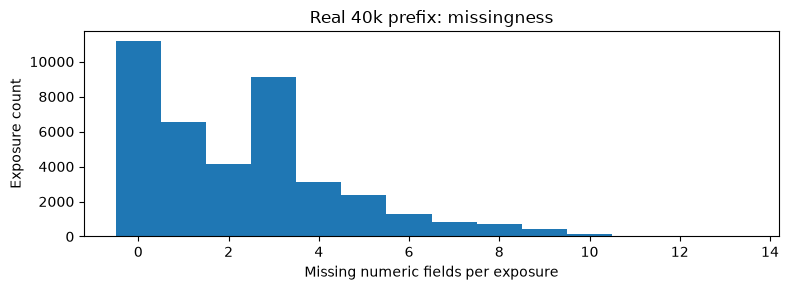
只改一个变量:标签变化不应改变分区
行号随机切分可能把完全相同特征的曝光分到训练与评估。当前实现对39个特征哈希分组,不包含label;同一个组总在同一分区。它只能避免完全重复向量的泄漏,不能消除同用户、同会话或时间相关性。无公开用户ID和可靠分片时间戳,所以不能声称用户或时间隔离。
执行原始分区,再只翻转label。分区必须完全相同。训练、select、calibration和audit各自做什么,应能在看结果前说清楚。
masks,groups=split_groups(frame)
flipped=frame.copy();flipped['label']=1-flipped.label
changed,newgroups=split_groups(flipped)
assert np.array_equal(groups,newgroups)
for a,ma in masks.items():
    for b,mb in masks.items():
        if a!=b: assert not set(groups[ma])&set(groups[mb])
display(pd.DataFrame({name:{'rows':int(mask.sum()),'clicks':int(y[mask].sum())} for name,mask in masks.items()}).T)
print('Label flip leaves all feature-group partitions unchanged.')
Notebook 保存的输出 · 本页未执行
| rows | clicks | |
|---|---|---|
| train | 22024 | 677 |
| select | 6006 | 194 |
| calibration | 6008 | 161 |
| audit | 5962 | 168 |
Label flip leaves all feature-group partitions unchanged.
重复拷贝压力测试:明确的机制输入
原始前缀的重复可能极少。为了测试规则,下面人为复制100行特征,不能把这些拷贝计入真实曝光统计。只改变“切分单位”:随机行 versus 相同特征组。随机行会把复制品分散,组切分保持一致。这是程序不变量检查,不是新数据实验成绩。
toy=pd.concat([frame.iloc[:500],frame.iloc[:100]],ignore_index=True)
gm,gh=split_groups(toy)
rng=np.random.default_rng(42);random_train=rng.random(len(toy))<.55
random_overlap=set(gh[random_train])&set(gh[~random_train])
print('Constructed duplicate stress test, random-row group overlap:',len(random_overlap))
assert not set(gh[gm['train']])&set(gh[~gm['train']])
print('Grouped overlap: 0; synthetic copies are excluded from all reported real metrics.')
Notebook 保存的输出 · 本页未执行
Constructed duplicate stress test, random-row group overlap: 43
Grouped overlap: 0; synthetic copies are excluded from all reported real metrics.
词表也要遵守训练边界
类别映射必须只从train学习;如果扫描评估数据再决定top类别,已经改变了学习协议。原模型使用每字段最多255个训练高频类别,未见/稀有归到0。先猜保留类别越多是否一定更好,再检查覆盖。之后可在select做预算实验,不能按audit反复选择。
练习:只将limit从32改到64,观察unknown/other比例与编码维度;不要修改split阈值以追求好看的点击率。解释为什么“全字段已见”仍不意味着用户已见。
from reclab.ads import vocabulary,encode
limit=32  # Exercise: change only this to 64.
vocab=vocabulary(frame.loc[masks['train']],limit)
x=encode(frame,vocab)
assert x.shape==(len(frame),39)
print('Encoded shape:',x.shape,'category other fraction on select:',float((x[masks['select'],13:]==0).mean()))
print('Interpret: fixed width does not imply fixed information; vocabulary breadth changes coverage.')
Notebook 保存的输出 · 本页未执行
Encoded shape: (40000, 39) category other fraction on select: 0.2871423448346525
Interpret: fixed width does not imply fixed information; vocabulary breadth changes coverage.