A14 · 预算节奏与反馈控制
先修:公用31–34;A13。
证据类型:明确构造机制实验(非真实广告日志)。本章不声称工业系统复现或线上收益。
学习顺序:先预测 → 只改一个变量 → 运行 → 解释结果。
问题与输入输出契约
旧24章累计比例门控是硬阈值。这里控制m_t=clip(m_{t-1}+η(target_t-spend_{t-1})/B),报价=.7m_t;它是比例误差的积分式反馈教学变体,非完整PID或最优控制。无节奏、硬门控、反馈三策略在同样价格序列比较;每请求先检查支付≤剩余预算。匀速花费不等于价值最大化,控制器也不能保证最终花完。
运行前预测:本章只改变的变量会使哪一项结果变化?哪些不变量必须保持?
PYTHON · 01
from pathlib import Path
import sys
root=Path.cwd()
if not (root/'reclab').exists(): root=root.parent
if str(root) not in sys.path: sys.path.insert(0,str(root))
import numpy as np
import pandas as pd
import matplotlib.pyplot as plt
from reclab import ads_curriculum as ac
运行单变量对照
输入是源码中可见的小型构造数据,输出单位和约束按上文定义。运行断言核验数学与账本。
PYTHON · 02
summaries=[]
for pattern in ('burst','sparse','drift'):
 for policy in ('none','gate','feedback'):
  r=ac.pacing(pattern,policy);summaries.append({k:v for k,v in r.items() if k!='trace'})
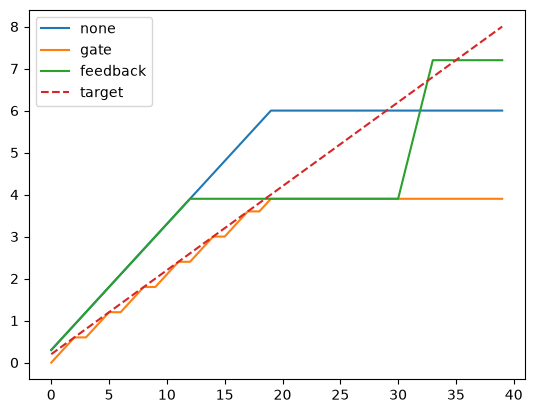
  if pattern=='drift': plt.plot([x['spend'] for x in r['trace']],label=policy)
display(pd.DataFrame(summaries));plt.plot([x['target'] for x in r['trace']],label='target',linestyle='--');plt.legend();plt.show()
assert all(r['spend']<=8+1e-12 for r in summaries)
Notebook 保存的输出 · 本页未执行
| pattern | policy | spend | value | |
|---|---|---|---|---|
| 0 | burst | none | 4.0 | 20.0 |
| 1 | burst | gate | 3.8 | 19.0 |
| 2 | burst | feedback | 7.2 | 24.0 |
| 3 | sparse | none | 3.0 | 10.0 |
| 4 | sparse | gate | 3.0 | 10.0 |
| 5 | sparse | feedback | 7.5 | 9.0 |
| 6 | drift | none | 6.0 | 20.0 |
| 7 | drift | gate | 3.9 | 13.0 |
| 8 | drift | feedback | 7.2 | 16.0 |
<Figure size 640x480 with 1 Axes>
解释与局限
在稀疏流量中可能欠花,漂移后反馈可提高报价但受限于剩余预算;不要删掉控制器未胜出的情景。当前每次赢标价值相同,若价值随时间变化,追求匀速可能牺牲高价值机会。
查看源码,再做练习
只把gain从.8改成2,比较累计误差与振荡;再解释为什么无需为花完预算购买低于成本的价值。
PYTHON · 03
import inspect
print(inspect.getsource(ac.pacing))
Notebook 保存的输出 · 本页未执行
def pacing(pattern='burst', policy='feedback', budget=8., gain=.8):
    if pattern not in ('burst','sparse','drift') or policy not in ('none','gate','feedback'): raise ValueError('Invalid scenario')
    prices={'burst':[.2]*20+[.8]*20,'sparse':[1.5]*30+[.3]*10,'drift':[.3]*20+[1.1]*20}[pattern]
    spend=0.; multiplier=1.; trace=[]; value=0.
    for t,price in enumerate(prices):
        target=budget*(t+1)/len(prices)
        if policy=='feedback' and budget>0: multiplier=float(np.clip(multiplier+gain*(target-spend)/budget,.05,3.))
        bid=(.7*multiplier if policy=='feedback' else .7)
        allowed=policy!='gate' or spend+price<=target
        win=allowed and bid>=price and spend+price<=budget+1e-12
        if win: spend+=price;value+=1.
        trace.append(dict(t=t+1,target=target,spend=spend,multiplier=multiplier,won=bool(win)))
        assert -1e-12<=spend<=budget+1e-12
    return dict(pattern=pattern,policy=policy,spend=spend,value=value,trace=trace)
来源与下一步
A-RTB 118–131页。这是Lab自行设计的小实验,不复制讲义全文。
GitHub中文单章 · 作者RTB讲义。中文PPT不是现代广告工程全套课;不将历史平台机制描述当作当前市场事实。
完成练习后回到广告学习路径,继续下一语义单元。