17 · 真实搜索:词法、语义、融合与重排
这是同一搜推广告系统的搜索迭代。复用 reclab.experiments、排序指标、粗索引、FastAPI 与工作台;不从推荐日志伪造查询。
先预测:生物医学领域,通用 MiniLM 是否必然优于 BM25?TinyBERT 重排能否找回候选集之外的论文?粗索引探测全部簇是否等价于精确检索?
数据边界:BEIR SciFact 全部 5,183 篇文档、300 个测试查询。按查询 ID 字典序选 200/809 个训练查询,仅训练小型线性排序器。所有模型参数、RRF 常数与候选预算事先固定,不按测试成绩调参。神经模型冻结,无神经微调;不是完整 BEIR 论文复现。未判断文档按不相关计分,不能据此证实负相关。
from pathlib import Path
import os, sys
root = Path.cwd()
if not (root / "reclab").exists(): root = root.parent
os.chdir(root)
sys.path.insert(0, str(root))
import pandas as pd
import numpy as np
import matplotlib.pyplot as plt
from reclab.search import latest, verify_sources, BM25, rrf
from reclab.retrieval import topk
receipt, result = latest()
verify_sources()
print(receipt['run_id'], result['scope'])
print('所有20项公开输入SHA已核验;数据/权重不进入Git。')
Notebook 保存的输出 · 本页未执行
20261030T124927-d1467622 SciFact BEIR: all 5,183 documents, all 300 test queries; 200 lexicographically selected train queries; frozen MiniLM/TinyBERT, no neural fine-tuning. Unjudged documents treated as nonrelevant, not verified negatives.
所有20项公开输入SHA已核验;数据/权重不进入Git。
查看实际实验
MiniLM:6层、384维、归一化 mean pooling,最多256 wordpieces。TinyBERT:2层交叉编码器,最多256个联合tokens。BM25使用全语料词频;RRF对两个前100结果按 1/(60+rank) 求和。重排只看融合前20,不能提高前20的候选召回上限。
线性模型在训练查询前20候选上,以 BM25、余弦、RRF、查询词覆盖和篇幅为特征拟合 LogisticRegression。未判断候选作为弱负标签,可能存在假负例。其输出用于排序,不声称为校准相关概率。
table = pd.DataFrame(result['rows']).set_index('method')
display(table.round(4))
fig, axes = plt.subplots(1, 2, figsize=(12, 4))
table[['ndcg@10','recall@10']].plot.barh(ax=axes[0], title='SciFact: relevance (binary qrels)')
table[['latency_p50_ms','latency_p95_ms']].plot.barh(ax=axes[1], title='Warm CPU query latency (ms)')
plt.tight_layout(); plt.show()
print('候选Recall@20:', result['rerank_candidate_recall@20'])
print('近似索引:', result['approximation'])
assert result['approximation']['dense_coarse12']['exact_top10_agreement'] == 1.0
Notebook 保存的输出 · 本页未执行
| recall@10 | ndcg@10 | mrr@10 | hit_rate@10 | recall@100 | latency_p50_ms | latency_p95_ms | known_positive_fraction@10 | |
|---|---|---|---|---|---|---|---|---|
| method | ||||||||
| bm25 | 0.7909 | 0.6617 | 0.6276 | 0.8100 | 0.8859 | 2.3056 | 3.0286 | 0.0873 |
| dense | 0.7883 | 0.6484 | 0.6068 | 0.8000 | 0.9250 | 13.2233 | 14.7887 | 0.0890 |
| hybrid_rrf | 0.8089 | 0.6855 | 0.6510 | 0.8267 | 0.9550 | 15.6706 | 17.3551 | 0.0907 |
| linear_rerank | 0.8107 | 0.7034 | 0.6747 | 0.8267 | 0.8752 | 17.1305 | 18.8177 | 0.0910 |
| tinybert_rerank | 0.7868 | 0.6670 | 0.6357 | 0.8000 | 0.8752 | 50.9085 | 55.7259 | 0.0890 |
| dense_coarse2 | 0.6242 | 0.5153 | 0.4848 | 0.6367 | 0.6942 | 12.9576 | 14.7254 | 0.0723 |
| dense_coarse12 | 0.7883 | 0.6484 | 0.6068 | 0.8000 | 0.9250 | 14.4022 | 16.2226 | 0.0890 |
<Figure size 1200x400 with 2 Axes>
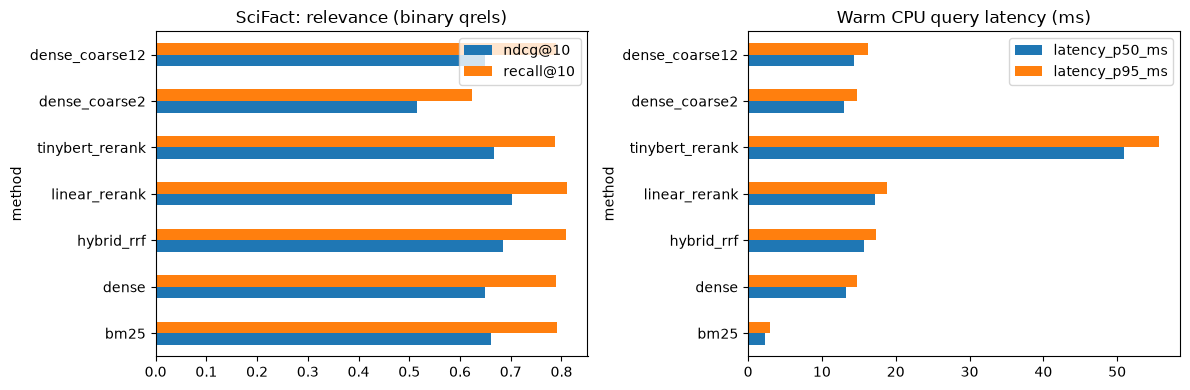
候选Recall@20: 0.8752222222222222
近似索引: {'dense_coarse2': {'exact_top10_agreement': 0.7679999999999999, 'mean_candidates': 879.9366666666666}, 'dense_coarse12': {'exact_top10_agreement': 1.0, 'mean_candidates': 5183.0}}
只改一个变量:融合深度
先预测:只取一个通道的首名与取前两名,融合结果如何变化?下面是构造排名的机制检查,绝不是 SciFact 成绩。把 depth=1 改为2再运行,并解释变化。要得到真实数据新成绩,显式运行 run(Config(candidate_depth=..., rerank_depth=...));每次新建实验,不覆盖既有训练。
延迟是实测逐查询CPU墙钟时间,含查询tokenization、编码、排序与对应重排;不含模型加载、离线语料编码、磁盘、HTTP。各方法混合顺序测量,不能当生产QPS。
toy_rankings = [[2, 1, 3], [3, 1, 2]]
for depth in [1, 2]:
    print('depth', depth, topk(rrf(toy_rankings, 3, depth=depth), 3))
# 查看正式算法源码;本格不自动训练。
import inspect
from reclab import search
print(inspect.getsource(search.rrf))
Notebook 保存的输出 · 本页未执行
depth 1 [2, 3]
depth 2 [1, 2, 3]
def rrf(rankings, n_documents, depth=100, constant=60):
    scores = np.zeros(n_documents + 1)
    scores[0] = -np.inf
    for ranking in rankings:
        for rank, doc in enumerate(ranking[:depth], 1):
            scores[doc] += 1 / (constant + rank)
    # Documents outside the candidate union must never fill a truncated candidate list.
    scores[scores == 0] = -np.inf
    return scores
失败案例与候选上限
按 TinyBERT 相对 BM25 的 NDCG 降幅排序,查看固定8个查询,不能只挑获胜案例。不同查询可能涉及词汇缺失、领域术语、截断、标注稀疏或预训练领域差异;这些是待验证解释,不是因果结论。
解释对照:找一个 BM25 命中而重排退化的查询;先检查前20是否包含目标,再区分召回失败与排序失败。完整逐查询列表保存在本机实验目录 per_query.json。
for failure in result['failures'][:3]:
    print('Query ID', failure['qid'])
    print('Relevant documents', failure['relevant_document_ids'])
    display(pd.DataFrame(failure['metrics']).T[['ndcg@10','mrr@10','recall@10']].round(3))
    # 本机 result['failures'] 可查看原查询/标题;Git只保留ID与精简指标。
# 数值上确认:在同一前20候选集内重排,Recall@100必须相同。
assert np.isclose(table.loc['linear_rerank','recall@100'], result['rerank_candidate_recall@20'])
assert np.isclose(table.loc['tinybert_rerank','recall@100'], result['rerank_candidate_recall@20'])
Notebook 保存的输出 · 本页未执行
Query ID 1363
Relevant documents ['8290953']
| ndcg@10 | mrr@10 | recall@10 | |
|---|---|---|---|
| bm25 | 1.000 | 1.000 | 1.0 |
| dense | 0.000 | 0.000 | 0.0 |
| hybrid_rrf | 0.333 | 0.143 | 1.0 |
| linear_rerank | 1.000 | 1.000 | 1.0 |
| tinybert_rerank | 0.000 | 0.000 | 0.0 |
| dense_coarse2 | 0.000 | 0.000 | 0.0 |
| dense_coarse12 | 0.000 | 0.000 | 0.0 |
Query ID 659
Relevant documents ['1215116']
| ndcg@10 | mrr@10 | recall@10 | |
|---|---|---|---|
| bm25 | 1.0 | 1.0 | 1.0 |
| dense | 1.0 | 1.0 | 1.0 |
| hybrid_rrf | 1.0 | 1.0 | 1.0 |
| linear_rerank | 1.0 | 1.0 | 1.0 |
| tinybert_rerank | 0.0 | 0.0 | 0.0 |
| dense_coarse2 | 0.0 | 0.0 | 0.0 |
| dense_coarse12 | 1.0 | 1.0 | 1.0 |
Query ID 660
Relevant documents ['1215116']
| ndcg@10 | mrr@10 | recall@10 | |
|---|---|---|---|
| bm25 | 1.000 | 1.000 | 1.0 |
| dense | 0.000 | 0.000 | 0.0 |
| hybrid_rrf | 0.315 | 0.125 | 1.0 |
| linear_rerank | 0.000 | 0.000 | 0.0 |
| tinybert_rerank | 0.000 | 0.000 | 0.0 |
| dense_coarse2 | 0.000 | 0.000 | 0.0 |
| dense_coarse12 | 0.000 | 0.000 | 0.0 |
如何复现与继续
.venv/bin/python -m reclab.search --download
.venv/bin/python scripts/execute_notebooks.py --only 17_Search_Experiments
新实验进入同一07工作台和 /api/experiments/search/{run_id}。工作台可输入英文声明,实际检索这套本机语料。
数据原作者 · BEIR数据CC BY-SA 4.0 · MiniLM Apache-2.0 · TinyBERT Apache-2.0。固定版本与SHA见 docs/search_sources.json。英文科学证据检索不代表通用网络搜索;预训练语料可能重叠,不声称严格无泄漏基准或医学结论。