12 · 冠军核心:把协同过滤分数变成特征
目标
手算一个 ItemCF 相似度,核对原版代码,解释一条真实推荐。 “特征工程”在这里是可查看的数字:市场商品计数、评分统计、不同市场语料训练的模型分数。
准备
PYTHON · 01
from pathlib import Path
import sys, json, inspect
ROOT = Path.cwd()
if not (ROOT / "reclab").is_dir():
    ROOT = ROOT.parent
sys.path.insert(0, str(ROOT))
import numpy as np
import pandas as pd
import matplotlib.pyplot as plt
from IPython.display import display, Code
from reclab.competition import data
from reclab.competition.teaching import load_run, style, bar_scores
style()
pd.set_option("display.max_columns", 12)
pd.set_option("display.max_rows", 40)
run, rows, features = load_run()
print("实际训练快照:", run.name)
Notebook 保存的输出 · 本页未执行
实际训练快照: 20261030T115556803593-cloud-restore
步骤 1 · 手算 IUF
二值历史矩阵 B,用户 u 的历史长度为 n_u:
S_ij = sum_u[B_ui B_uj / log(1+n_u)] / sqrt(count_i count_j),令对角线为 0。
活跃用户连接很多商品,因此共现权重更小。用户候选分数为其历史商品到候选商品的相似度之和。
PYTHON · 02
B = np.array([[1., 1., 0.], [0., 1., 1.], [1., 1., 1.]])
weights = 1 / np.log1p(B.sum(axis=1))
cooccur = B.T @ (weights[:, None] * B)
counts = B.sum(axis=0)
similarity = cooccur / np.sqrt(counts[:, None] * counts[None, :])
np.fill_diagonal(similarity, 0)
manual_01 = (1 / np.log(3) + 1 / np.log(4)) / np.sqrt(2 * 3)
assert np.isclose(similarity[0, 1], manual_01)
display(pd.DataFrame(similarity, index=["item A", "item B", "item C"], columns=["item A", "item B", "item C"]))
print("用户历史[A,B] -> C:", similarity[0, 2] + similarity[1, 2])
Notebook 保存的输出 · 本页未执行
| item A | item B | item C | |
|---|---|---|---|
| item A | 0.000000 | 0.666093 | 0.360674 |
| item B | 0.666093 | 0.000000 | 0.666093 |
| item C | 0.360674 | 0.666093 | 0.000000 |
用户历史[A,B] -> C: 1.026766260457602
步骤 2 · 与固定版本的冠军代码数值对照
只提取经过校验的原类用于对照,不执行它的脚本入口、安装器或路径配置。 IUF 和 rating-cosine 是两种分数;原方案 rating-cosine 查询时也对历史做无评分权重求和。
PYTHON · 03
from reclab.competition.reference import verify_references
parity = verify_references()
display(parity)
from reclab.competition.memory import ItemCF
display(Code(inspect.getsource(ItemCF.fit), language="python"))
Notebook 保存的输出 · 本页未执行
lgn is already to go(dropout:False)
{'memory': {'iuf': {'max_score_error': 1.6360444821117426e-07, 'pairs': 384},
  'rating': {'max_score_error': 8.096896113585217e-07, 'pairs': 384}},
 'graph': {'loss_error': 0.0, 'gradient_max_error': 4.656612873077393e-10},
 'data': 't1 real training histories',
 'users': 8}
def fit(self, frame):
self.users, self.items, ratings = encode(frame)
binary = ratings.copy()
binary.data[:] = 1
self.history = binary
values = ratings if self.kind == "rating" else binary
if self.kind == "iuf":
weight = 1 / np.log1p(np.diff(binary.indptr))
weighted = values.multiply(weight[:, None]).tocsr()
else:
weighted = values
sim = (values.T @ weighted).tocsr()
norm = np.sqrt(np.asarray(values.power(2).sum(axis=0)).ravel())
inv = 1 / np.maximum(norm, 1e-12)
sim = sim.multiply(inv[:, None]).multiply(inv[None, :]).tocsr()
sim.setdiag(0)
sim.eliminate_zeros()
if self.top_k:
for row in range(sim.shape[0]):
a, b = sim.indptr[row:row + 2]
if b - a > self.top_k:
ids = np.lexsort((sim.indices[a:b], -sim.data[a:b]))[self.top_k:]
sim.data[a + ids] = 0
sim.eliminate_zeros()
self.similarity = sim
self.popularity = np.asarray(binary.sum(axis=0)).ravel()
return self步骤 3 · 拆开真实候选分数
载入全数据实际训练产物,不重新训练现有模型。相似度贡献之和必须等于候选分数。
可以直接修改 USER 为同市场其他用户。
PYTHON · 04
from reclab.competition.experiment import load_memory
model = load_memory(run / "memory/t1_local")
USER = rows.query("market == 't1'").userId.iloc[0]
subset = rows[(rows.market == "t1") & rows.userId.eq(USER)].copy()
subset["score"] = model.score(subset)
display(subset.sort_values("score", ascending=False).head(10))
ITEM = subset.sort_values(["score", "itemId"], ascending=[False, True]).itemId.iloc[0]
explanation = pd.DataFrame(model.explain(USER, ITEM))
display(explanation.head(10))
assert np.isclose(explanation.similarity.sum(), subset.loc[subset.itemId.eq(ITEM), "score"].iloc[0])
Notebook 保存的输出 · 本页未执行
| userId | itemId | market | label | partition | score | |
|---|---|---|---|---|---|---|
| 80 | t1U1005570 | P1000949 | t1 | 0 | fit | 0.091353 |
| 0 | t1U1005570 | P1005811 | t1 | 0 | fit | 0.075901 |
| 73 | t1U1005570 | P1021121 | t1 | 0 | fit | 0.069835 |
| 61 | t1U1005570 | P1033291 | t1 | 0 | fit | 0.068454 |
| 57 | t1U1005570 | P1012526 | t1 | 0 | fit | 0.050017 |
| 79 | t1U1005570 | P1008851 | t1 | 0 | fit | 0.039970 |
| 56 | t1U1005570 | P1035707 | t1 | 0 | fit | 0.036421 |
| 43 | t1U1005570 | P1021561 | t1 | 0 | fit | 0.032723 |
| 71 | t1U1005570 | P1012765 | t1 | 0 | fit | 0.032284 |
| 66 | t1U1005570 | P1029597 | t1 | 0 | fit | 0.031917 |
| history_item | similarity | |
|---|---|---|
| 0 | P1031263 | 0.068887 |
| 1 | P1020517 | 0.012866 |
| 2 | P1021106 | 0.006505 |
| 3 | P1014278 | 0.003095 |
| 4 | P1030052 | 0.000000 |
步骤 4 · 同一 user-item 到底有哪些特征
一行同时包含多个市场的商品计数、t1 自身统计和多个模型分数。ID 和 label 不进入排序特征。 没有真实属性表,这套竞赛复现不会假造类目或用户画像。
PYTHON · 05
position = subset.index[0]
display(features.loc[position].rename("value").to_frame())
assert not {"label", "userId", "itemId", "partition"} & set(features)
table = pd.read_csv(run / "metrics.csv")
selected = table[(table.partition == "select") & (table.market.isin(["t1", "t2"])) & table.model.isin(["icf_local", "icf_s1", "icf_s3", "icf_all_iuf"])]
display(selected.pivot(index="model", columns="market", values="ndcg10"))
Notebook 保存的输出 · 本页未执行
| value | |
|---|---|
| s1_train_item_count | 7.000000 |
| s1_train_5core_item_count | 0.000000 |
| s2_train_item_count | 7.000000 |
| s2_train_5core_item_count | 2.000000 |
| s3_train_item_count | 11.000000 |
| s3_train_5core_item_count | 2.000000 |
| t1_train_item_count | 19.000000 |
| t1_train_5core_item_count | 11.000000 |
| target_user_rating_count | 5.000000 |
| target_user_rating_mean | 4.800000 |
| target_item_rating_count | 19.000000 |
| target_item_rating_mean | 3.736842 |
| t2_train_item_count | 6.000000 |
| t2_train_5core_item_count | 0.000000 |
| icf_local | 0.075901 |
| icf_s1 | 0.046836 |
| icf_s3 | 0.055958 |
| icf_all_iuf | 0.030729 |
| icf_all_rating | 0.093117 |
| graph_layers0 | -0.083863 |
| graph_layers2 | 0.229921 |
| market | t1 | t2 |
|---|---|---|
| model | ||
| icf_all_iuf | 0.684087 | 0.586053 |
| icf_local | 0.673879 | 0.562058 |
| icf_s1 | 0.683179 | 0.582342 |
| icf_s3 | 0.675800 | 0.565388 |
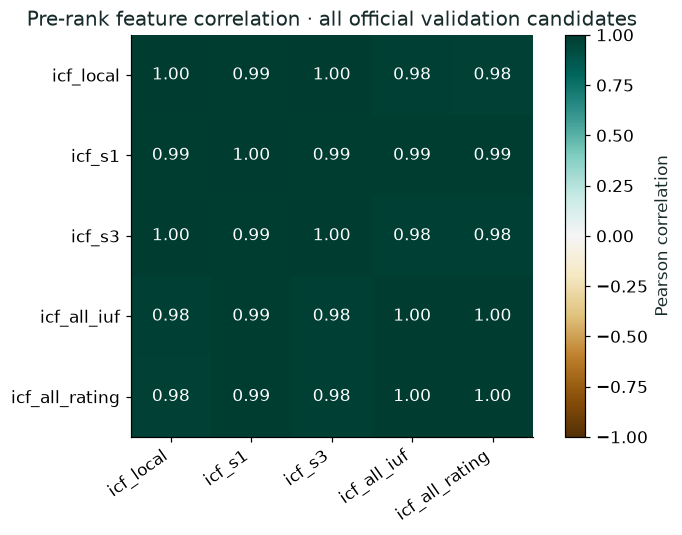
PYTHON · 06
columns = ["icf_local", "icf_s1", "icf_s3", "icf_all_iuf", "icf_all_rating"]
correlation = features[columns].corr()
fig, ax = plt.subplots(figsize=(7, 5))
image = ax.imshow(correlation, vmin=-1, vmax=1, cmap="BrBG")
ax.set_xticks(range(len(columns)), columns, rotation=35, ha="right")
ax.set_yticks(range(len(columns)), columns)
for i in range(len(columns)):
    for j in range(len(columns)):
        ax.text(j, i, f"{correlation.iloc[i,j]:.2f}", ha="center", va="center", color="white" if abs(correlation.iloc[i,j]) > .65 else "black")
ax.set_title("Pre-rank feature correlation · all official validation candidates")
fig.colorbar(image, ax=ax, label="Pearson correlation")
fig.tight_layout()
plt.show()
Notebook 保存的输出 · 本页未执行
<Figure size 770x550 with 2 Axes>
对照论文的实际分数
下面是无需目标验证标签训练的 ItemCF,在完整官方验证集上的结果。论文 Table 4 的数字是固定参考值,不与 LightGBM 的训练内分数混用。合并按用户数加权。本地有确定的 item-ID 同分规则,不能要求与原方案逐位相等。
PYTHON · 07
full = table[(table.partition == "all_official_valid") & (table.model == "icf_local")][["market", "users", "ndcg10"]].copy()
full["paper_table4"] = full.market.map({"t1": .6776, "t2": .5589, "combined": .5980})
full["local_minus_paper"] = full.ndcg10 - full.paper_table4
display(full)
print("本地合并 nDCG@10:", round(float(full.loc[full.market.eq("combined"), "ndcg10"].iloc[0]), 6))
Notebook 保存的输出 · 本页未执行
| market | users | ndcg10 | paper_table4 | local_minus_paper | |
|---|---|---|---|---|---|
| 15 | t1 | 2697 | 0.677494 | 0.6776 | -0.000106 |
| 16 | t2 | 5482 | 0.558946 | 0.5589 | 0.000046 |
| 17 | combined | 8179 | 0.598037 | 0.5980 | 0.000037 |
本地合并 nDCG@10: 0.598037
检查与下一步
相关系数接近 1 的两个特征是否只能删掉一个?