11 · 真实竞赛:从题目走到一条预测
目标
为缺少交互的市场 t1、t2 推荐商品,利用 s1、s2、s3 的共享商品信息。 你将读取完整官方数据,从 100 件给定商品中排序。每个用户只有一个验证正例,成功指标是 nDCG@10。
本轮以 OPDAI 冠军公开方案为依据。 官方排行榜冠军分数 0.6773 是当年隐藏测试成绩,本地不会把验证成绩冒充这个分数。 这里复现了冠军核心算法与两阶段流程,缩小图模型、特征集合和集成规模。完整差异见复现说明。
顺序:12 特征 → 13 采样与图模型 → 14 重训排序器 → 15 评估。
准备
当前内核使用项目 .venv。下载只需首次执行 python -m reclab.competition prepare;本轮已经下载并核对校验和。
from pathlib import Path
import sys, json, inspect
ROOT = Path.cwd()
if not (ROOT / "reclab").is_dir():
    ROOT = ROOT.parent
sys.path.insert(0, str(ROOT))
import numpy as np
import pandas as pd
import matplotlib.pyplot as plt
from IPython.display import display, Code
from reclab.competition import data
from reclab.competition.teaching import load_run, style, bar_scores
style()
pd.set_option("display.max_columns", 12)
pd.set_option("display.max_rows", 40)
run, rows, features = load_run()
print("实际训练快照:", run.name)
Notebook 保存的输出 · 本页未执行
Matplotlib is building the font cache; this may take a moment.
实际训练快照: 20261030T115556803593-cloud-restore
步骤 1 · 先明确哪些文件能进训练
train.tsv 是评分交互;train_5core.tsv 是经过筛选的正反馈,不是未点击曝光。
冠军将 5core 的评分改成 5,再按 user-item 去重,优先保留原 train 的记录。
目标市场的 qrel 不能进入特征训练语料。官方没有公开隐藏测试标签。
summary = []
for market in data.MARKETS:
    train = data.interactions(market)
    combined = data.corpus([market])
    summary.append({"market": market, "raw_train_rows": len(train),
                    "duplicate_user_item_pairs": int(train.duplicated(["userId", "itemId"]).sum()),
                    "merged_rows": len(combined), "users": combined.userId.nunique(),
                    "items": combined.itemId.nunique()})
summary = pd.DataFrame(summary)
display(summary)
display(data.interactions("t1").head(5))
Notebook 保存的输出 · 本页未执行
| market | raw_train_rows | duplicate_user_item_pairs | merged_rows | users | items | |
|---|---|---|---|---|---|---|
| 0 | s1 | 840212 | 39564 | 809095 | 141508 | 35518 |
| 1 | s2 | 115549 | 1147 | 130077 | 20327 | 5172 |
| 2 | s3 | 54202 | 789 | 57113 | 8627 | 2922 |
| 3 | t1 | 60168 | 1392 | 60400 | 9955 | 3543 |
| 4 | t2 | 120320 | 1690 | 120178 | 18504 | 8919 |
| userId | itemId | rating | |
|---|---|---|---|
| 0 | t1U1006129 | P1016853 | 5.0 |
| 1 | t1U1002135 | P1019605 | 5.0 |
| 2 | t1U1006710 | P1032538 | 5.0 |
| 3 | t1U1007418 | P1012632 | 5.0 |
| 4 | t1U1008062 | P1022775 | 5.0 |
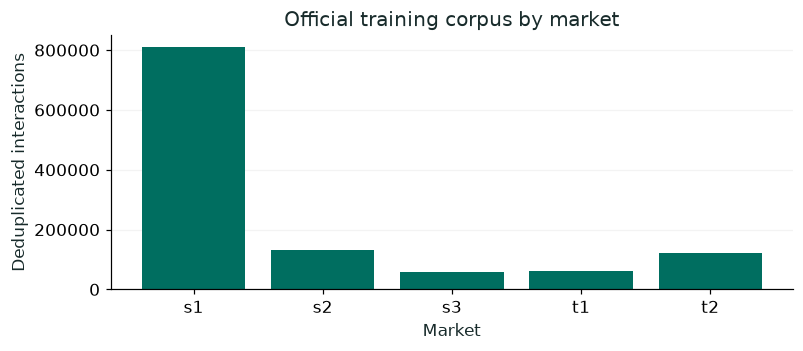
fig, ax = plt.subplots(figsize=(8, 3))
ax.bar(summary.market, summary.merged_rows, color="#006e60")
ax.set(xlabel="Market", ylabel="Deduplicated interactions", title="Official training corpus by market")
ax.grid(axis="y", alpha=.15)
plt.show()
Notebook 保存的输出 · 本页未执行
<Figure size 880x330 with 1 Axes>
步骤 2 · 跟踪一个真实用户
每行不是一次曝光;它是竞赛给定的候选商品之一。label=0 表示不是本次被留出的那个正例,不能解释成真实业务“不喜欢”。
用户和商品 ID 都已匿名化,数据没有时间戳、商品标题、价格或可解释的国家名。不能在这里伪造“最近 7 天热度”等特征。
user = rows.query("market == 't1'").userId.iloc[0]
example = rows[(rows.market == "t1") & (rows.userId == user)]
known = data.corpus(["t1"])
display(known[known.userId.eq(user)].head(10))
display(example.head(8))
print("候选数:", len(example), "正例数:", int(example.label.sum()))
print("正例 ID:", example.loc[example.label.eq(1), "itemId"].iloc[0])
Notebook 保存的输出 · 本页未执行
| userId | itemId | rating | |
|---|---|---|---|
| 6380 | t1U1005570 | P1030052 | 5.0 |
| 7115 | t1U1005570 | P1021106 | 5.0 |
| 9808 | t1U1005570 | P1014278 | 5.0 |
| 12074 | t1U1005570 | P1020517 | 5.0 |
| 13319 | t1U1005570 | P1031263 | 4.0 |
| userId | itemId | market | label | partition | |
|---|---|---|---|---|---|
| 0 | t1U1005570 | P1005811 | t1 | 0 | fit |
| 1 | t1U1005570 | P1035751 | t1 | 0 | fit |
| 2 | t1U1005570 | P1007542 | t1 | 0 | fit |
| 3 | t1U1005570 | P1035694 | t1 | 0 | fit |
| 4 | t1U1005570 | P1006599 | t1 | 0 | fit |
| 5 | t1U1005570 | P1012377 | t1 | 0 | fit |
| 6 | t1U1005570 | P1026761 | t1 | 0 | fit |
| 7 | t1U1005570 | P1004549 | t1 | 0 | fit |
候选数: 100 正例数: 1
正例 ID: P1026107
步骤 3 · 查看实际运行结果的来源
全数据特征生成后,官方验证用户按稳定哈希分为约 60% fit、20% select、20% audit。 fit 训练排序器,select 选模型,选定后才查看 audit。所有候选行跟着用户一起分组。 原方案是 10 折行级 bagging;此处改成用户隔离的本地实验流程。
receipt = json.loads((run / "receipt.json").read_text())
display(pd.Series(receipt))
display(rows.groupby(["market", "partition"]).userId.nunique().unstack())
assert rows.groupby(["market", "userId"]).partition.nunique().eq(1).all()
source = json.loads(data.SPEC.read_text())
print("官方数据版本:", source["official_revision"])
print("冠军源码版本:", source["winner_revision"])
print("原始文件校验数:", len(source["files"]))
Notebook 保存的输出 · 本页未执行
run_id                  20261030T115556803593-cloud-restore
selected                                         lgb_memory
seconds                                          164.998926
peak_rss_mib                                    1782.796875
official_valid_users                                   8179
features                                                 21
status                                                 PASS
hidden_test_score                                      None
lightgbm_threads                                          1
dtype: object
| partition | audit | fit | select |
|---|---|---|---|
| market | |||
| t1 | 543 | 1616 | 538 |
| t2 | 1062 | 3267 | 1153 |
官方数据版本: f5b1f087a4054537cd8f46bf346f978094b8467e
冠军源码版本: 8af3260368b1980a85a555fc470caa84bf6697d6
原始文件校验数: 22
检查理解
如果把 qrel 的正例加入 t1 的交互矩阵,再评估这批用户,为什么分数会变好?